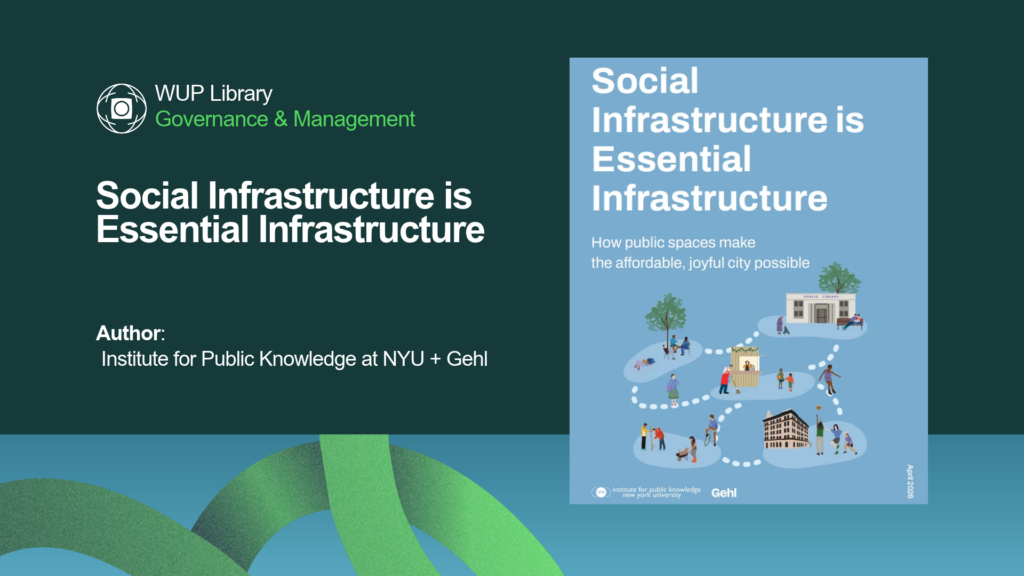
What makes a city truly livable is not only housing, transit, or utilities—it is also the everyday places where people can rest, play, learn, create, and feel part of something bigger. Social Infrastructure is Essential Infrastructure explores how parks, libraries, recreation centers, sidewalks, plazas, community gardens, skateparks, and transit stops form the social backbone of...
Category: <span>Articles and documents</span>
Developing Local Communities through Sustainable Tourism: A Roadmap
Key insight: Most community tourism projects don’t fail because the idea was flawed. They fail because an outside agency builds the infrastructure, cuts the ribbon, and leaves — handing the community a project it never truly owned. That’s exactly where this roadmap begins. That honest starting point is what makes the document useful. Instead of...
Behavioral Guide for Urban Spaces II
The conversation continues — and this time, it goes quieter, deeper, and closer to the ground. The first guide taught us to read the loud, visible behaviors: how people walk, sit, wait, and belong. This second volume tunes the ear to the subtle signals — the ones that shape how cities function, adapt, and endure...
Behavioral Guide for Urban Spaces
The city is already talking. The question is whether we’re listening. Most urban design starts with a plan and hopes people will follow it. This guide flips that logic. It starts with people — how they actually walk, sit, wait, gather, and sometimes quietly rebel against the spaces we build — and turns those everyday...
Guide to Creating Urban Public Spaces for Children (SPACES)
The number that frames everything: globally, only 44% of urban residents live near an open public space — and in low- and middle-income countries that figure drops to 30%. As motorization, privatization, and sprawl erase child-friendly areas, a generation is growing up with fewer safe places to play, learn, and simply be children. What it...
Designing with Empathy: A Practical Guide to AI Personas for Inclusive Architecture & Urbanism
Can a machine help us design for the people a plan usually forgets? This guide makes an honest case that it can — as long as it never decides alone. When a park or plaza is first sketched, whose experience is actually in the room? Workshops and surveys are essential, but they tend to reach...
A Global Board for a Global Mission
2026 Nominations Now Open
Two elected seats — a Young Leader and a Park/City Agency Representative —
are open ahead of the 2026 AGM. An invitation to help shape the strategic
direction of our international community of practice.
Accommodating Growth in Latin American and Caribbean Cities
What if the way your city grows today determines whether future residents ever get access to a park, a tree, or a breath of fresh air? That’s not a rhetorical question — it’s the urgent reality documented in Accommodating Growth in Latin American and Caribbean Cities, a groundbreaking new report jointly produced by the Inter-American...
The Nature-Based Solutions Opportunity Scan
The Nature-Based Solutions Opportunity Scan provides a strategic framework for identifying where nature can deliver climate, resilience, and community benefits at scale. The document positions nature-based solutions (NbS) not as isolated environmental projects, but as cross-cutting investments that address flooding, heat, biodiversity loss, water security, and social wellbeing simultaneously. By scanning ecological, economic, and urban...
A Method for Evaluating Urban Structure for Well-Being Using NDVI and Pedestrian Flow Data
This research introduces an innovative framework for understanding how urban greenery influences human well-being by combining satellite-derived vegetation data (NDVI) with large-scale pedestrian flow analysis. Moving beyond traditional measurements of park size or canopy coverage, the study develops the Cumulative Green Spaces Exposure Time (CGSET) indicator, which evaluates how long people are exposed to greenery...